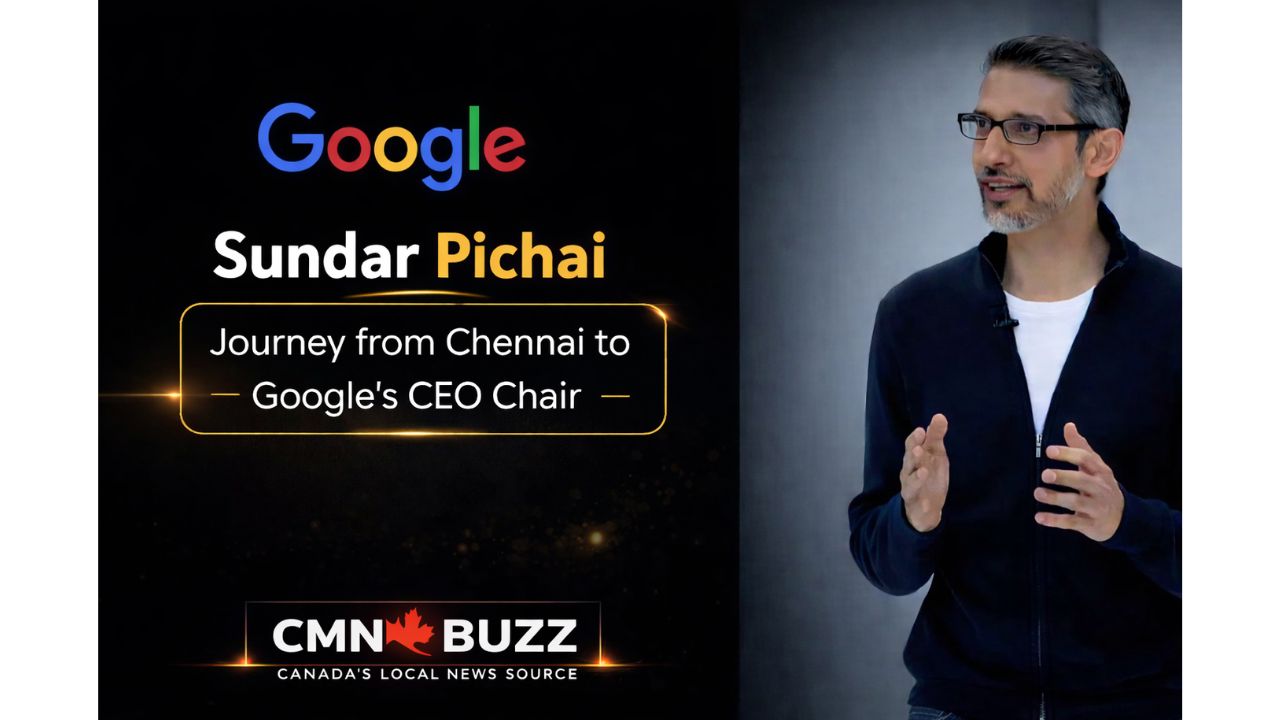
Sundar Pichai’s rise to the top of the global technology industry is often described as inspirational, but for professionals planning long-term careers in technology, leadership, and innovation, his journey offers far more than motivation. It provides a clear, practical example of how skills, adaptability, and strategic thinking can shape a career that remains relevant across decades of change.
Today, as CEO of Google and its parent company Alphabet, Sundar Pichai oversees one of the most influential technology ecosystems in the world. His career path, however, did not begin in boardrooms or Silicon Valley campuses. It began in a modest household, shaped by scarcity, curiosity, and a deep appreciation for learning. For students, immigrants, and early-career professionals alike, his story offers valuable lessons that remain applicable well into the future.
Early Life and the Foundations of Long-Term Thinking
Born in 1972 and raised in Chennai, India, Sundar Pichai grew up in a middle-class family where resources were limited and access to technology was rare. One widely cited detail from his childhood is the family’s long wait for a telephone connection, an experience that later influenced his belief that technology should be accessible and useful to everyday people, not just the privileged few.
Even as a child, Pichai displayed an exceptional memory and analytical ability. He was known for recalling complex information with ease, including phone numbers and technical details. More important than raw intelligence, however, was his early habit of observing how systems worked and how they could be improved. This mindset, developed long before formal leadership roles, became a recurring theme throughout his career.
Education as a Strategic Tool, Not a Destination
Pichai’s academic path reflects a crucial lesson for modern professionals: education is not an endpoint, but a foundation. After completing his schooling in Chennai, he earned admission to the Indian Institute of Technology Kharagpur, where he studied Metallurgical Engineering. His academic excellence earned him recognition and a silver medal, but his interests extended well beyond coursework.
Rather than limiting himself to a single discipline, Pichai developed a broad understanding of technology, design, and problem-solving. This multidisciplinary thinking later proved critical as the technology industry shifted toward integrated platforms and user-centric products.
His move to the United States for graduate studies marked a turning point. With a scholarship to Stanford University, followed by an MBA from the Wharton School at the University of Pennsylvania, Pichai combined technical expertise with business strategy. Financial constraints during this period forced careful decision-making, reinforcing habits of discipline and long-term planning that remained central to his leadership style.
Entering Google and Building Influence Gradually
Sundar Pichai joined Google in 2004, not as a senior executive, but in product management. His early work focused on improving Google’s toolbar and search-related products, areas that demanded attention to user experience rather than flashy innovation.
At the time, the web browser market was dominated by established players, and the idea of Google launching its own browser was viewed skeptically by many industry observers. Pichai’s proposal for what would later become Google Chrome was initially met with resistance. His approach, however, was grounded in careful analysis rather than aggressive persuasion. He emphasized speed, simplicity, security, and user trust, values that eventually shaped Chrome into the world’s most widely used browser.
This phase of his career highlights an often overlooked lesson: influence is built over time. Pichai did not rely on bold promises or personal branding. Instead, he allowed results to speak, gradually earning trust within the organization.
Leadership in the Smartphone and Platform Era
As Google expanded into mobile technology, Pichai took on leadership of the Android operating system. The smartphone revolution reshaped global communication, commerce, and daily life, and Android became a central pillar of that transformation. Under his guidance, Android grew into the most widely deployed mobile operating system in the world.
What distinguished Pichai’s leadership during this period was his focus on ecosystem thinking. Rather than viewing success as dominance over competitors alone, he emphasized partnerships with device manufacturers, developers, and service providers. This collaborative approach helped Android scale globally and adapt to diverse markets.
For professionals studying career growth, this phase underscores the importance of adaptability. Pichai’s technical background allowed him to understand complex systems, while his business education helped him navigate global partnerships and long-term strategy.
Becoming CEO in an Era of Constant Change
In 2015, Google restructured its operations under a new parent company, Alphabet. Sundar Pichai was appointed CEO of Google, and in 2019, he assumed the role of CEO of Alphabet as well. Leading such a vast organization during a period of rapid technological and regulatory change required a different kind of leadership.
Rather than adopting a highly visible or confrontational style, Pichai became known for calm decision-making and measured communication. He frequently emphasized listening, internal debate, and incremental progress. This approach proved particularly important as Google faced increasing scrutiny over data privacy, competition policy, and the societal impact of technology.
His appearances before legislative bodies in the United States and Europe demonstrated an ability to explain complex issues with clarity and restraint, reinforcing trust even amid criticism. For future leaders, this illustrates the value of composure and credibility in high-pressure environments.
Artificial Intelligence and the Future of Work
One of the most significant shifts during Pichai’s tenure has been Google’s move toward an “AI-first” strategy. Rather than treating artificial intelligence as a standalone feature, Google integrated it across products, services, and infrastructure. The development of advanced AI models, including the Gemini family, reflects this long-term vision.
Pichai has consistently framed AI as a tool to augment human capability rather than replace it. This perspective has particular relevance for professionals concerned about automation and job displacement. His emphasis on continuous learning, reskilling, and responsible deployment suggests a roadmap for navigating technological disruption without fear.
Work, Family, and Sustainable Success
Despite his demanding role, Sundar Pichai is often cited as an example of balanced leadership. He has spoken openly about setting boundaries around technology use at home and prioritizing family time. For professionals striving for longevity rather than burnout, this aspect of his life reinforces an essential truth: sustainable success requires personal discipline as much as professional ambition.
Lessons for Professionals Planning Long-Term Careers
Sundar Pichai’s career offers several enduring lessons. First, early limitations do not define future outcomes when paired with curiosity and perseverance. Second, adaptability and learning across disciplines are critical in industries shaped by constant change. Third, leadership built on trust, clarity, and humility can scale across organizations and cultures.
For immigrants, students, and professionals in countries like Canada and beyond, his journey demonstrates that global leadership is increasingly shaped by mindset rather than geography. Careers are no longer linear, and success often comes from the ability to evolve with technology rather than chase trends.
As technology continues to reshape work, communication, and society, Sundar Pichai’s story remains relevant not as a myth of overnight success, but as a practical guide to building a career that endures.
For a Malayalam news perspective on this topic, read the full report here.
Share your thoughts and questions about this news in the comment box below. For more information, visit our website or email us at cmnbuzzcanada@gmail.com. Follow CMN Buzz on social media to stay updated with all major news from Canada in real-time.
Stay tuned to CMN Buzz — Your trusted partner for news that shapes the future of immigrant life in Canada